
Why Do Paramedics Use Dark Humor on the Job?

Updated: Aug 4
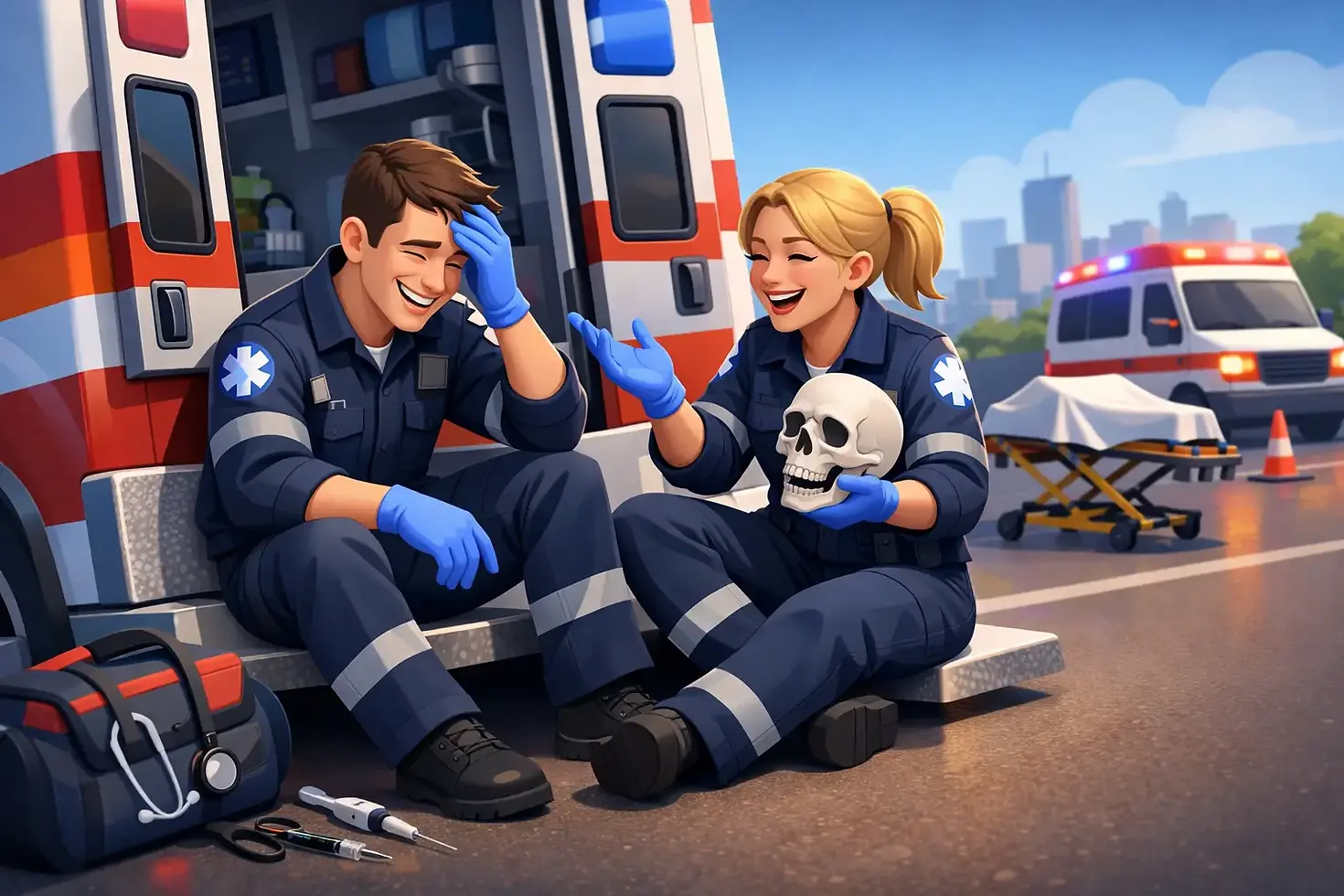
A pediatric code clears, the rig gets restocked, and somebody says something so wrong that the whole crew laughs for three seconds. Then they go quiet and finish checking the airway bag.
That moment is why "Why do paramedics use dark humor?" is never a question with one clean answer. It is not because paramedics do not care. More often, it is because they care enough to feel the full weight of what just happened, and the job still expects them to answer the next call.
Dark humor is part of EMS culture because it does something useful in an environment where fear, grief, bodily fluids, violence, and absurdity can all show up before lunch. It gives people a little distance from the thing that is trying to live rent-free in their head. But it also has limits. A joke can be a pressure valve. It can also become a hiding place.
Why Do Paramedics Use Dark Humor?
Paramedics work in a job where the stakes are real and immediate. The patient may be dying. A family member may be screaming. The scene may be unsafe, chaotic, or painfully familiar. Then the report is written, the truck is turned over, and the unit is back in service.
There is rarely a clean emotional off-ramp between calls. Dark humor creates one small beat of release. It lets a crew acknowledge, without delivering a speech, that what they just saw was awful, bizarre, or too much to hold with a straight face.
The laughter is not usually about the patient. It is about the impossible contrast between normal life and the things responders are asked to treat as routine. It is about a system that sends you from a fatal wreck to a toe pain at 3 a.m. It is about surviving the absurdity without letting it hollow you out.
To people outside the field, that distinction can be hard to hear. A bad joke at the wrong time sounds cold. Sometimes it is cold. But often it is a form of emotional triage: deal with what is in front of you now, store the rest somewhere temporary, and keep moving until it is safe to feel it.
The Importance of Crew Trust
A good partner is more than someone who can start a line, drive smoothly, or catch a missing piece of equipment before it becomes a problem. A good partner learns your tells. They know when you are quiet because you are tired and when you are quiet because a call got under your skin.
Shared humor can build that kind of trust quickly. It says, “You saw that too. You understand why it hit weird. You do not need to explain the whole scene to me.” In a profession full of short staffing, missed meals, bad sleep, and long transports, that feeling of being understood matters.
This is why the same joke can land completely differently depending on who is in the room. Among a crew that has earned one another’s trust, it may be a release. Around a patient, family member, student, or someone new to the culture, it can be careless and harmful. Context is not a minor detail. It is the whole call.
Dark humor is often an insider language. That does not make every use of it acceptable. It means the people using it need to remember that belonging is not a free pass to lose basic respect.
Humor Creates Distance, Not Immunity
There is a reason people joke after hard calls. The brain looks for a way to reduce the intensity. Laughing can interrupt the loop for a minute. It can make a horrific image feel less immediate. It can get someone through the drive back to the station without falling apart in the cab.
That can be useful. It can also be misunderstood as processing.
Making a joke about a traumatic call does not mean the call is handled. It may mean the person has found a way to function for the next hour. Those are different things. A medic can be funny, clinically sharp, and deeply not okay all at once.
The job rewards functioning. It rewards showing up tired, compartmentalizing fast, and being the calm voice in someone else’s worst day. What it does not always reward is admitting that a call stayed with you. So humor becomes one of the safest ways to signal pain without having to say, “That messed me up.”
Sometimes the crew hears the signal. Sometimes everyone laughs, changes the subject, and carries it alone.
When Dark Humor Turns Into a Warning Sign
Not every grim joke means someone is spiraling. EMS has always had a gallows-humor streak, and a healthy crew can laugh hard while still treating patients with skill and dignity. The concern is not humor itself. The concern is what comes with it.
Pay attention when the jokes get meaner, more constant, or more detached from the situation. Pay attention when someone who used to be engaged with patients now talks about everybody like they are a problem. Pay attention when humor is paired with rage, isolation, drinking more after shift, reckless behavior, sleep that never improves, or a medic who cannot stop replaying one particular call.
Those are not character flaws. They are signs that the load may be getting heavier than the coping tools available.
There is also a difference between laughing with the crew after a tough call and joking where patients or families can hear. The first may protect the team. The second can destroy trust in seconds. Patients do not need a polished performance, but they do deserve to know the people caring for them see them as human beings.
Professionalism in EMS does not require pretending you are untouched. It requires knowing where the line is and protecting the people on both sides of it.
The Cost of Never Taking the Mask Off
The danger is not that paramedics laugh. The danger is when laughter becomes the only language they are allowed to use for pain.
If every hard call becomes a meme, a one-liner, or a story told louder at the kitchen table, the real reaction can stay buried for years. It tends to surface somewhere else: in an argument at home, in numbness, in a short fuse with a partner, in dread before shift, or in that strange feeling of being physically present and mentally nowhere.
This is where generic wellness slogans usually lose the room. A poster cannot fix a culture that treats honest struggle like a liability. Neither can telling people to “practice self-care” after a 24-hour shift with no relief crew and a full inbox.
What helps is more practical. Check on the person who went quiet after the bad call. Ask a direct question without turning it into an interrogation. Offer to sit in the bay, grab food, take a walk, or make the call to peer support together. If someone says they are not okay, believe them before they have to prove it.
“The strong need help too” is not a soft message. It is an operational one. A burned-out medic does not become safer by being told to toughen up. A crew gets safer when people can speak before the stress turns into something dangerous.
Balancing Humor and Humanity
Dark humor is not a moral failure. For many paramedics, it is part of how they survive a job that regularly puts them close to pain most people never have to see. It can build crews, cut tension, and make another impossible shift feel survivable.
But it should never be the only tool in the bag. The joke can get you through the moment. The conversation afterward is what helps keep the moment from following you home.
So laugh if you need to laugh. Just know your people well enough to notice when the funny one has stopped being okay, and be the partner who makes it safe to say so.
Conclusion
In the end, dark humor is a double-edged sword. It can be a lifeline or a mask. We must navigate it carefully. Let’s keep the laughter, but also create space for real conversations. Together, we can foster a culture that values both humor and humanity.


Comments